
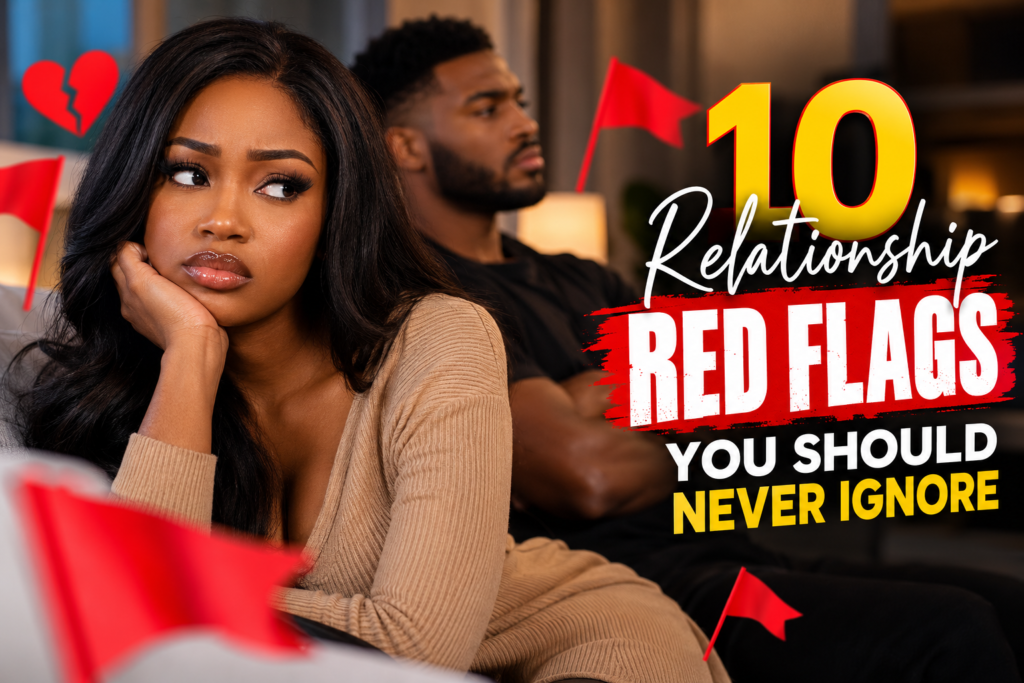
This list presents 10 Relationship Red Flags you should never ignore.
However, love can make us see the best in someone. Sometimes, unfortunately, it can also make us explain away things. We would notice them if they happened to a friend. Recognizing Relationship Red Flags can help you see truth.
And sometimes, people genuinely make mistakes and grow from them.
But there is a difference between an occasional mistake and a repeated pattern that leaves you feeling disrespected, controlled, unsafe, or emotionally exhausted.
That is why knowing the common relationship red flags matters.
A red flag doesn’t automatically mean a relationship must end. But it is a reason to pause, pay attention, communicate honestly, and consider whether the relationship is healthy for you.
Here are 10 relationship red flags you should never ignore.
1. They Constantly Disrespect You
Disrespect can show up in many ways.
It may be obvious, such as insulting you, embarrassing you in front of other people, mocking your appearance, or deliberately saying things they know will hurt you.
Sometimes it is quieter.
They may dismiss your opinions, make jokes at your expense, talk over you, or treat your feelings as though they are unimportant.
One bad moment doesn’t necessarily define a person. Everyone can lose their temper or say something they regret.
The bigger question is:
What happens after you tell them that their behavior hurt you?
A healthy partner should be capable of listening, taking responsibility, apologizing, and making an effort to do better.
Repeated disrespect shouldn’t become something you simply learn to tolerate. Another relationship red flags you should never ignore is:
2. They Try to Control Who You See and What You Do
There is a difference between caring about your partner and controlling them.
A controlling partner may decide who you’re allowed to talk to, what you should wear, where you can go, or how you should spend your time.
They may become angry whenever you spend time with friends or family.
Sometimes control is disguised as love:
“I’m only doing this because I care about you.”
But love should not require you to surrender your independence.
A healthy relationship allows two people to remain individuals while building a life together.
3. You Are Always Walking on Eggshells
Do you constantly worry about saying the wrong thing?
Are you always studying your partner’s mood before you speak?
Do you find yourself changing your behavior simply to avoid an argument or angry reaction?
Feeling nervous around your partner on a regular basis can be an important warning sign.
Relationships will naturally have disagreements. But you shouldn’t feel as though one wrong sentence could cause an emotional explosion.
Peace doesn’t mean a relationship never has conflict.
It means you should be able to communicate without constantly being afraid of your partner’s reaction.
If you’re constantly trying to figure out whether his behavior means he is losing interest or simply pulling back emotionally, you may also want to read [Why Men Pull Away].
4. They Lie Repeatedly
Everyone makes mistakes. But repeated lying can seriously damage trust.
It could involve money, friendships, communication with an ex, where they have been, or other important parts of their life.
The problem isn’t always the individual lie.
It’s the pattern.
When someone repeatedly hides the truth and only admits it after being confronted, you may eventually find yourself questioning everything they tell you.
And once trust becomes fragile, even innocent situations can become difficult.
A healthy relationship needs honesty because emotional intimacy cannot grow properly without trust.
5. They Manipulate You Emotionally
Emotional manipulation can be difficult to recognize because it isn’t always dramatic.
It can sound like:
“If you really loved me, you would do this.”
“Everything is always my fault because of you.”
“You’re too sensitive.”
“You’re imagining things.”
Manipulation often makes you question your feelings, memories, or judgment.
Instead of discussing a problem honestly, the other person turns the situation around until you feel guilty for bringing it up.
Pay attention to how you feel after difficult conversations.
Do you feel heard and understood?
Or do you constantly leave the conversation feeling guilty, confused, and responsible for everything?
6. They Never Take Responsibility
Relationships require two people who can admit when they are wrong.
If your partner never apologizes, never accepts responsibility, and always finds someone else to blame, problems can become impossible to solve.
Maybe it’s always their ex’s fault.
Their parents’ fault.
Their friends’ fault.
Your fault.
Everyone’s fault except theirs.
People are allowed to make mistakes. What matters is whether they can acknowledge those mistakes and learn from them.
A simple “I was wrong, and I’m sorry” can say a lot about someone’s willingness to grow.
7. They Constantly Break Your Boundaries
Boundaries are not punishments.
They are limits that communicate what you are and aren’t comfortable with.
For example, you may tell your partner that you don’t want them reading your private messages, insulting you during arguments, or involving other people in your personal disagreements.
A healthy partner may not always agree with your boundary, but they should be willing to discuss it and respect reasonable limits.
If you clearly communicate a boundary and someone repeatedly crosses it, that’s worth taking seriously.
Especially when they know exactly what they’re doing.
Healthy boundaries should protect both partners and allow each person to communicate what they are and aren’t comfortable with. Love Is Respect: What Are My Boundaries?
Love Is Respect specifically explains that healthy relationships involve communicating and respecting boundaries.
8. They Isolate You From People Who Love You
One of the more concerning relationship warning signs is when your partner consistently tries to separate you from your support system.
They may constantly criticise your friends.
They may create arguments whenever you visit your family.
They may insist that nobody understands your relationship except them.
Over time, you may find yourself becoming increasingly isolated.
Healthy love doesn’t require you to abandon everyone else.
Your partner can become an important part of your life without becoming your entire world.
9. They Make You Feel Like You Are Never Enough
You shouldn’t have to constantly audition for your partner’s love.
If someone repeatedly compares you with other people, criticizes your appearance, belittles your achievements, or makes you feel lucky that they “put up with you,” pay attention.
Constructive feedback is different from constant criticism.
A loving partner can tell you when something needs to change without making you feel worthless.
You should be able to grow inside a relationship without constantly feeling as though you’re failing some invisible test.
Sometimes, what looks like insecurity can become a pattern of constantly seeking reassurance from someone who isn’t giving you the emotional security you need. Read [Are You in a Relationship or Just Being Kept Around?] to understand more about emotional attachment.
10. You Don’t Feel Safe Being Yourself
This may be the biggest red flag of all.
Think about who you are when you’re with this person.
Can you laugh freely?
Can you express your opinion?
Can you admit when you’re hurt?
Can you say no?
Can you have different interests?
Can you make mistakes without being humiliated?
Or are you constantly performing a version of yourself that you think your partner will accept?
A healthy relationship should give you room to be a whole person.
You shouldn’t have to shrink yourself just to keep someone in your life.
Not Every Relationship Problem Is a Red Flag
This is important.
Having arguments doesn’t automatically mean your relationship is unhealthy.
Different opinions don’t automatically mean you’re incompatible.
Your partner forgetting something once doesn’t necessarily mean they don’t care.
People are imperfect.
The key is to look for patterns.
Ask yourself:
- Does this happen repeatedly?
- Have I communicated how it makes me feel?
- Does my partner take responsibility?
- Do they make a genuine effort to change?
- Do I feel respected?
- Can we solve disagreements without intimidation or humiliation?
- Am I becoming less confident or more isolated because of this relationship?
Those questions can tell you much more than one bad day.
What Should You Do When You Notice Relationship Red Flags?
Don’t ignore something simply because you are afraid of losing the relationship.
Start by acknowledging what you’re seeing.
If it is safe to do so, talk to your partner about the behavior clearly and calmly. Explain what happened, how it affected you, and what you need to change.
Then pay attention to their response.
Promises matter less than consistent behavior.
Someone can say, “I’ll change” in five seconds.
Real change takes time, consistency, and accountability.
And if a relationship involves threats, intimidation, physical violence, sexual coercion, stalking, or other forms of abuse, prioritize your safety and seek support from someone you trust or an appropriate local support service.
You don’t have to handle serious situations alone.
Love should not require you to ignore your own well-being.
The right relationship won’t be perfect. There will be misunderstandings, disagreements, bad days, and moments when both people get things wrong.
But there should also be respect, honesty, communication, accountability, and room for both people to be themselves.
So if you’ve noticed some of these relationship red flags, don’t immediately panic.
Pause.
Look at the pattern.
Have the conversation.
And most importantly, don’t convince yourself that something is healthy simply because you desperately want the relationship to work.
Sometimes the hardest thing isn’t recognizing a red flag.
It’s accepting what it is telling you.
Your heart deserves love, but it also deserves peace.
If you’re concerned that a relationship may be unhealthy or abusive, The National Domestic Violence Hotline’s warning-sign guide provides additional information about behaviors such as control, isolation, intimidation and manipulation.
Frequently Asked Questions
What are the biggest red flags in a relationship?
Some major relationship red flags include repeated disrespect, controlling behavior, manipulation, constant lying, isolation from friends and family, repeated boundary violations, intimidation, and refusing to take responsibility for harmful behavior.
Is jealousy a red flag in a relationship?
Jealousy can happen in relationships and does not automatically mean a relationship is unhealthy. However, extreme or controlling jealousy—such as monitoring your phone, restricting who you can see, or accusing you constantly without evidence—can be a serious warning sign.
Can relationship red flags be fixed?
Some relationship problems can improve when both partners recognize the problem, communicate openly, take responsibility, and consistently change their behavior. However, patterns involving abuse, threats, coercion, or intimidation should be taken particularly seriously, with safety coming first.
How do I know if my relationship is unhealthy?
Look at the overall pattern. If you regularly feel disrespected, controlled, afraid, isolated, manipulated, or unable to be yourself, it may be worth taking a closer look at the relationship and seeking perspective from someone you trust.
Should I leave if I notice a relationship red flag?
A single red flag does not automatically determine what you should do. Consider the severity, frequency, your partner’s response when the issue is raised, whether meaningful change occurs, and whether you feel safe and respected in the relationship.
What relationship red flag have you learned never to ignore?
Share your thoughts in the comments. Someone reading your experience may need to hear it.